
Cool Class: Foundations in Sculpture
October 21, 2015
By Rob Humphreys
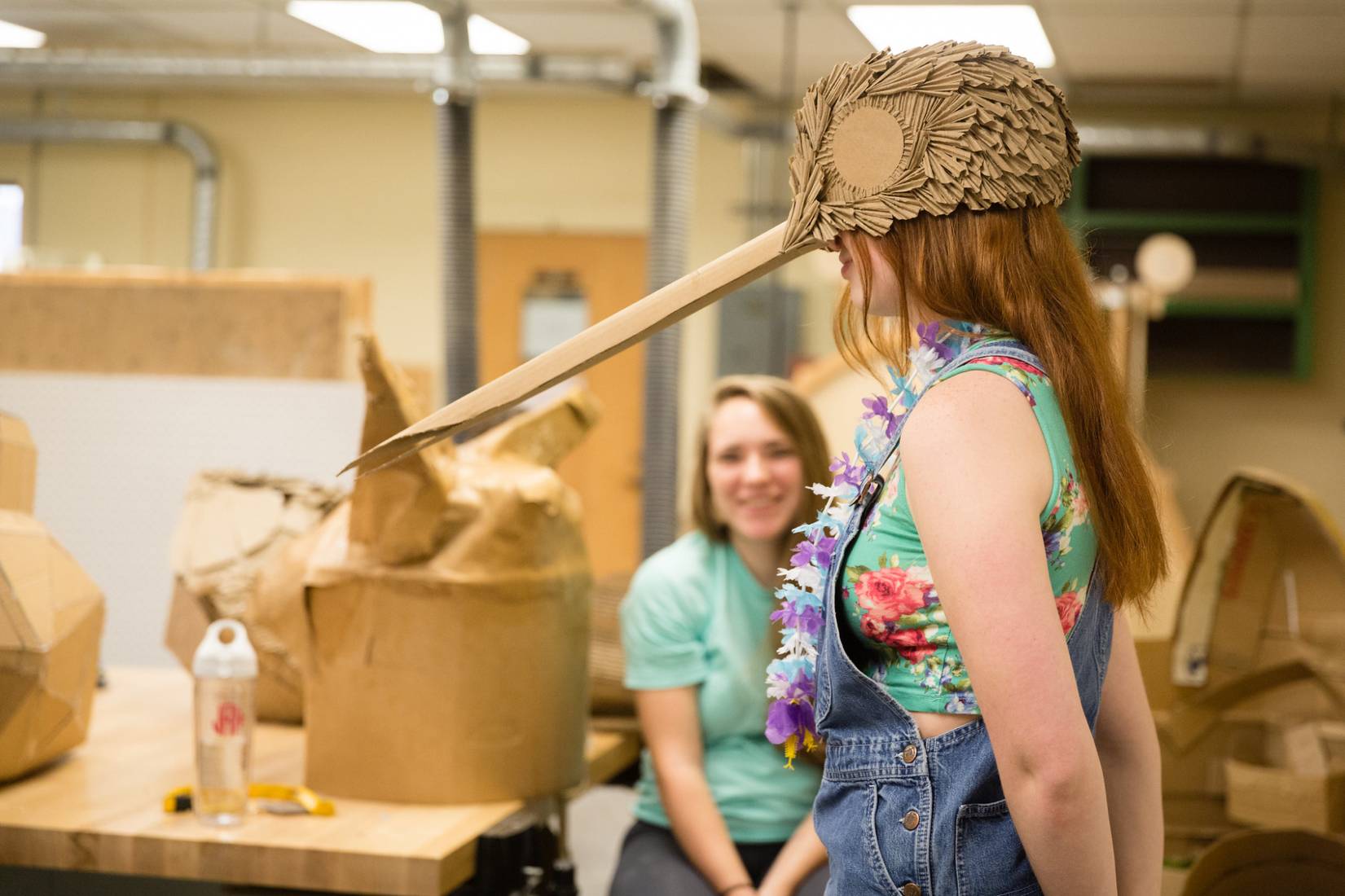
Connecting with their inner spirit animals, first-year students take a creative, hands-on approach to learning the foundations of a time-honored art form.
During the Renaissance, an artist’s three-dimensional creation (think Michelangelo’s David) was judged largely on technical qualities such as proportion, beauty, and life-like resemblance.
Today, sculpture is often a more abstract vehicle, an exploration into the very ideas and concepts that fuel individual expression.
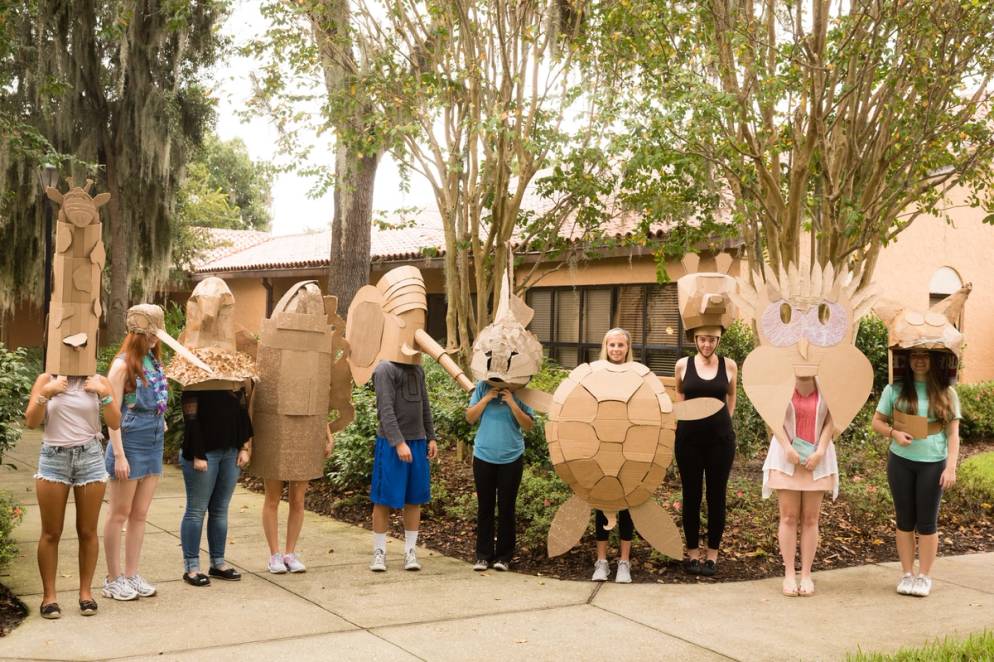
Through a series of studio assignments, first-year students in this Rollins College Conference (RCC) course are encouraged to develop their own sculptural vocabulary and a repertoire of practical techniques. Using their new skills to parade around as “spirit animals” is a fun bonus.
Course Title
Foundations in Sculpture: Constructing Meaning
Instructor
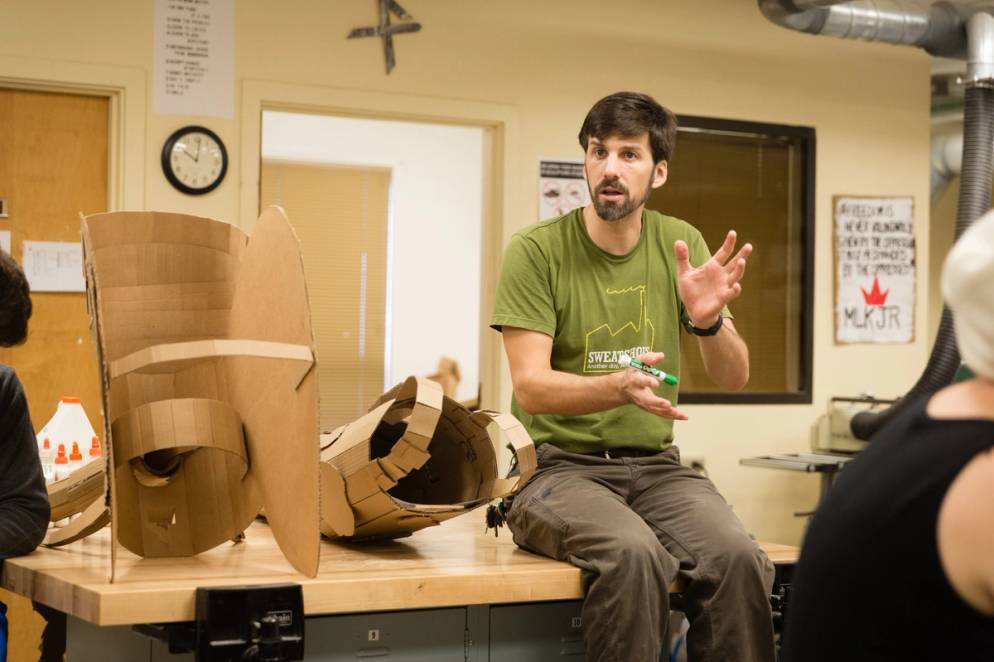
Joshua Almond, associate professor of studio art
The Scoop
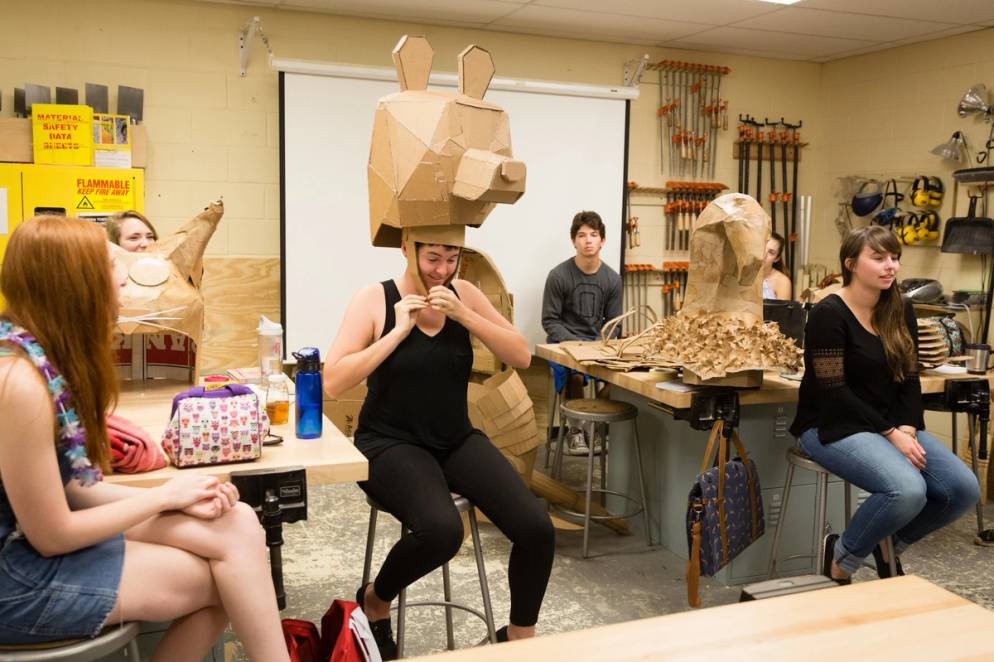
Students learn the fundamentals of sculpture with a hands-on approach that emphasizes spatial awareness, problem solving, and conceptual development. Allegory, metaphor, and symbolism are just as important as tools, materials, and techniques.
By focusing on conceptual development, students begin to think about the content of their work in a more sophisticated manner,” Almond says. “In addition, they realize they’re going to be pushed way outside their comfort zone and use materials—like wood and metal—that are intimidating and/or unfamiliar.”
Snapshot
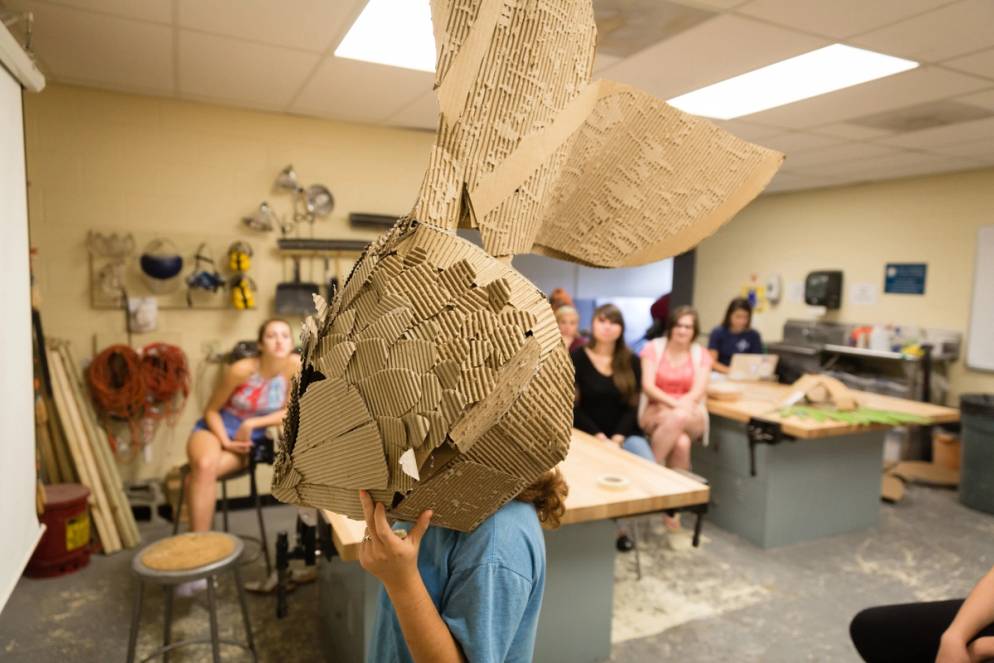
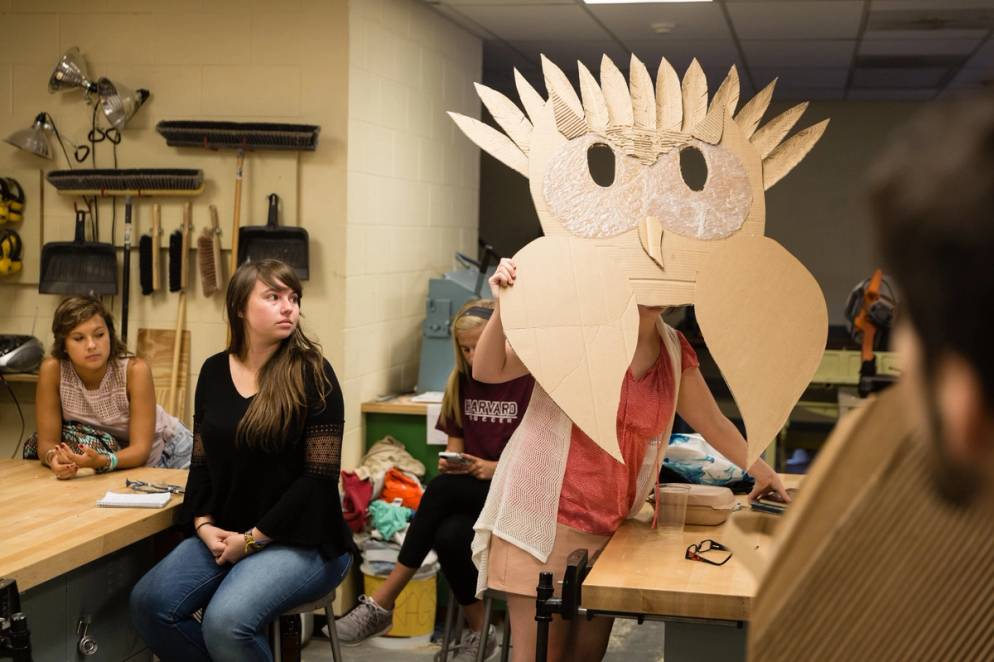
When we dropped in on the class September 28, students were modeling and showcasing their spirit animals. Made using cardboard, the wearable sculptures enabled them to explore identity and a three-dimensional form in space using a medium that doesn’t require a tremendous amount of skill to manipulate.
“The sculpture itself was going to transform their physical being in a new and interesting way,” Almond says. “We talked about how the assignment connects to various traditions and societies around the world where costumes are worn for spiritual or ritualistic purposes, and we used the idea of a spirit animal as a departure point.”
Student Perspective
Meredith Ewen ’19, who plans to major in art history, says the class has challenged her to explore new materials and concepts.
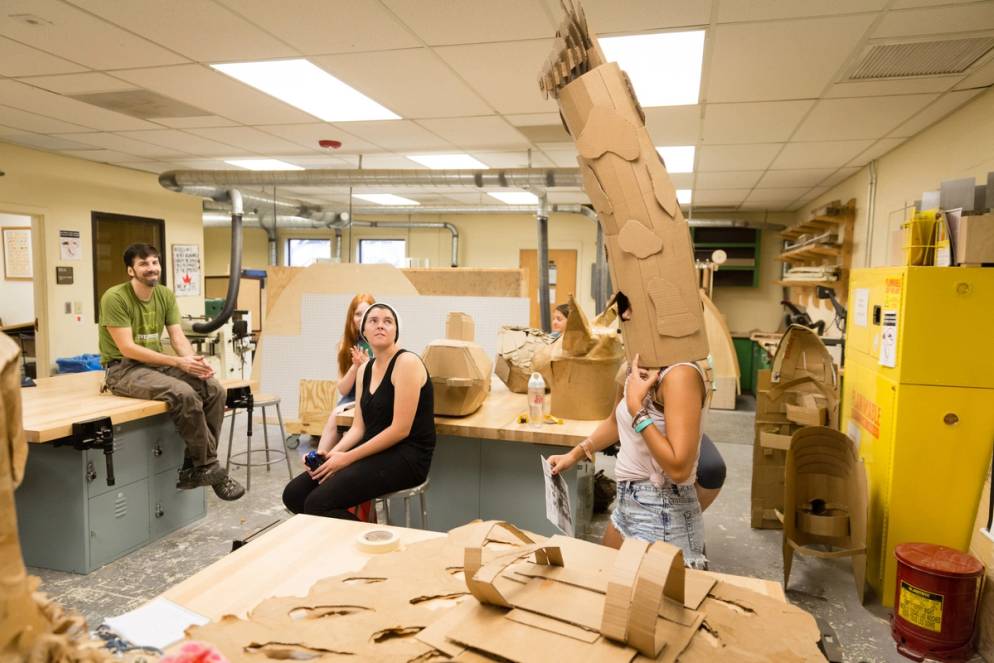
“These materials, while simple at first glance, have exposed me to the challenge of how to understand the ways the material or process is limited and how to then find ways to manipulate them to fit my design,” she says. “Overall, this class has taught me lessons of understanding and flexibility that transcend out of the studio space and into other realms of my college experience as I study and engage in the community.”
Fun Fact
Native American totem poles are a natural example of how sculpture intersects with “spirit animal” iconography. According to New World Encyclopedia, designs featuring bears, birds, frogs, lizards, and people—often endowed with arms, legs, and wings—were carved to illustrate stories, commemorate historic persons, represent shamanic powers, and provide objects of public ridicule.
Cool Classes
Go behind the scenes of dozens of Rollins’ most innovative courses.
Explore MoreExplore MoreRelated News
May 19, 2029
DO NOT PUBLISH Rollins President Brooke Barnett Co-Authors Inside Higher Ed Essay on Evaluating Advancement Teams
Rollins President Brooke Barnett co-authored an Inside Higher Ed essay offering academic leaders a framework for evaluating institutional advancement teams.
September 18, 2026
Rollins Ranks Among Top 100 National Liberal Arts Colleges and No. 1 in Florida
U.S. News & World Report has ranked Rollins among the top 100 national liberal arts colleges for 2027 and the No. 1 liberal arts college in Florida. Rollins was also ranked the nation’s No. 1 liberal arts college for veterans.
September 17, 2026
Rollins Museum of Art Premieres Fall 2026 Exhibition
The Rollins Museum of Art unveils a new exhibition for its fall season, which runs from September 11, 2026, to January 3, 2027.